Monday, February 3, 2020

Some Ontario Cannabis Stores Cut Hours Amid National Supply Shortage.


At least two legal Ontario cannabis retailers have cut their operating hours in response to the national cannabis shortage which has limited the availability of packaged cannabis products in stores across the country.


CBC News reported on Monday that Hobo Cannabis Store in Ottawa will close entirely on Wednesdays and will cut their hours on Tuesdays.

Then, on Wednesday, Canna Cabana, a store in Hamilton, tweeted that it would have to close on Sundays, saying that “even Ontario is not immune to supply issues” despite the province working with more than 35 producers.The next day, Canna Cabana’s owner Steven Fry, told the CBC that he has been selling out of product consistently and that if the province won’t send more than the 25 kilograms per week that each lawful store is allotted, he’ll have to continue with the weekly closure.
The province, for its part, allows retailers to open from 9 a.m. to 11 p.m. daily, although many Ontario stores are not open for the totality of those hours.

 It’s unclear if other legal retailers in the province are cutting their hours. Calls to a handful of stores went unanswered Thursday night, although the operating hours on the website of Toronto retailer Tokyo Smoke do not appear to have been altered since its opening.


A worker who answered the phone at Nova Cannabis on Queen Street West in Toronto said that the store had made an adjustment to its hours unrelated to the shortage—opening later and closing later on Sundays—but are otherwise operating at normal hours.

 January, a private retail store in Newfoundland closed, blaming the supply crunch felt by retailers in their province. The owner told the Toronto Star at the time her clientele wanted cannabis with more potent THC, which the store was only able to acquire in small amounts.


That was followed by reductions at some publicly-run stores in Quebec in the past months. In a sign things may be getting better, the SQDC announced last week that stores will now be open every day of the week, saying that a sufficient supply has now surfaced.
Whether there is a production shortage has itself become a point of contention. Health Canada said in February that the problem is not so much with the amount produced as it is “localized and product-specific shortages” since inventories of cannabis from producers were 18 times greater than monthly sales.

The Ontario government has indicated it wants to move forward with an open allotment system at some point. The province initially restricted the number of legal stores to 25 winners, awarded through a lottery.

While the regulation enabling the lottery is set too officially expire in December, this calls into question whether the province would be able to switch to an open allotment system earlier than that, as the industry had hoped.


Originally Posted on: https://www.leafly.ca/news/industry/ontario-retailers-cut-hours-shortage

Tuesday, January 21, 2020

Northern Nights Music Fest to Have Recreational Cannabis Sales & Consumption


The festival in the heart of the Emerald Triangle will be one of the first overnight, three-day festivals in the U.S. to legally allow recreational cannabis sales and consumption.

California’s Northern Nights Music Festival is continuing to push for the normalization of cannabis at live events as the annual festival announces the legal sale and consumption of weed. In the heart of the Emerald Triangle (the United States’ largest cannabis producing region made up of Humboldt, Mendocino, and Trinity Counties), Northern Nights will be a forerunner in overnight music festivals that is complaint with legal cannabis sales and consumption.

“We are going to have a cannabis retail and consumption area that goes by the name of the Tree Lounge. It is 21 and over area and cannabis sales and consumption are restricted to that area,” says Northern Nights co-founder and compliance manager Peter Huson. “Essentially it is an onsite temporary dispensary. It has all the same rules you would have at a dispensary, it’s just inside a festival.”

The Tree Lounge will have its own curated stage with live music including local hip-hop crews, surprise sets and DJs spinning dance hall, reggae and more. In addition, the area will feature activities such as CBD yoga, workshops, movement classes with cannabis and more.
Local Emerald Triangle growers will be on hand to sell their strains and educate attendees about their product and where it comes from.

“In the Tree Lounge, we are going to highlight the history and the culture and the small [cannabis] farmers of Humboldt and Mendocino counties,” says Northern Nights co-founder Andrew Blap. “You can come meet the farmers and see the people who have been growing weed for you for years. You never really put a face to the name, but now with legalization you can.”

Cannabis growers will also be sponsors of the Lounge and provide activities for consumers.
“These sponsors are really getting involved with different activations. For example, [local grower] Flow Kana is going to do a farm to bong competition. It will take local produce and vegetables and you’re going to be able to carve a bong and the winner will get announced each day,” Blap tells Billboard. “If we can promote some of the local brands then these attendees are going to think about that when they are buying weed the rest of the year.”

Northern Nights festival is located in the scenic, wooded atmosphere on the border of Humboldt and Mendocino Counties. Prior to the legalization of recreational cannabis use in the California, the festival was compliant with regulations that allowed designated consumption areas for those with medical licenses to use marijuana. Cannabis was officially legal in January of 2018, but open consumption was strictly relegated to county fairgrounds.
In September of 2018, the state introduced bill AB 2020 which allowed for counties to provide temporary permits for events with recreational use outside of fairgrounds. With the help from Northern Nights organizers, Humboldt County was swift to provide a permit for the summer festival taking place from July 19-21 partially in their jurisdiction.

“We are right in the middle of the Emerald Triangle on the border of Humboldt and Mendocino county. A lot of our staff and patrons are people that live and work around there and are related to the industry,” says Northern Nights talent and art director Matty Roberts.
California law does not allow for the recreational consumption of alcohol and cannabis in the same area, so Northern Nights has taken advantage of the fact that it resides in two counties. Cannabis consumption will be allowed on the Humboldt County side of the event, while alcohol consumption will be allowed on the Mendocino side without cannabis.

“Everyone is going to be comfortable in both the alcohol and the cannabis spaces,” Huson tells Billboard. “We separated them by county because our event happens on the county line with the idea that you can demonstrate compliance and responsible management of these areas. We want to help get to a point in the future where you could have both cannabis and alcohol in the same county and at the same event.”
Huson compares the Tree Lounge to 21-and-over beer gardens found at many music festivals across the country. The legal sale and consumption will also eliminate the need for festival-goers travel with cannabis or sneak marijuana into the event.

“The normalization of cannabis is a really positive thing,” says Roberts. “To be part of that, and to be a leader in that, we’re very honored and truly humbled to get to do that.”
Northern Nights returns to Humboldt and Mendocino Country at the Cook’s Valley Campground from July 19-21. For more information on the Tree Lounge, tickets and lineup, head here.


Thursday, January 9, 2020

Ice Cube to headline first licensed Cannabis Cup marijuana festival in Southern California.


Ice Cube is set to headline High Times Cannabis Cup SoCal 2019, which the magazine is billing as a “triumphant return” of its iconic cannabis festival to Southern California.
Last year’s Cannabis Cup almost didn’t happen, after organizers failed to land permits that were newly required in 2018 for all California events with marijuana consumption and sales. The confusion led to a steep drop in attendance from previous years, as vendors bailed and critics took to social media to blast the chaos.
That also turned out to be the norm. Not a single sanctioned cannabis event was held in Southern California last year, as festival organizers struggled to navigate the newly legal cannabis scene.
But High Times has already secured a permit from the city for this year’s festival, which is coming to National Orange Show Events Center on Memorial Day weekend, according to San Bernardino officials. And a state permit is in the works, paving the way for adults to legally buy and smoke marijuana during the two-day show.
“I’m happy to say that the promoters of this event have gone above and beyond to ensure compliance,” Mayor John Valdivia said via email. “We look forward to a safe and successful event.”
High Times magazine launched its Cannabis Cup circuit 30 years ago in its counterculture heyday. The festivals thrived during the era of California’s gray medical marijuana, with thousands of people flooding NOS Events Center and other venues a few times a year to listen to music and smoke weed.
The events were always dubiously legal, though, with organizers finding protection in medical marijuana laws by forcing attendees to get doctor’s recommendations for cannabis as they entered the gates.
California law that took effect Jan. 1, 2018 legalized recreational cannabis and said cannabis festivals could let anyone 21 and older buy and smoke weed. But the law also required festival organizers to get permission from state and local agencies.
That turned out to be a problem for Cannabis Cup. Less than 48 hours before the 2018 event was scheduled to start, the San Bernardino City Council voted not to issue a permit for the event, setting off rumors that the event was canceled or would be weed-free.
The Los Angeles-based company adapted. It agreed to file detailed site plans, pay thousands of dollars in licensing fees and submit to strict state and local regulations – such as blocking alcohol sales and only allowing state-licensed vendors. All was done with an eye toward hosting future events in California.
The company’s leadership also made campaign contributions to local elected officials, including $10,000 in August from High Times CEO Adam Levin to Valdivia’s ultimately successful campaign for mayor.
High Times landed the first state permit for a festival in Southern California earlier this year. In March, it promoted the High Times Dope Cup High Desert in Adelanto. And the company recently landed a permit from San Bernardino for Cannabis Cup.
It’s not clear what the rules will be on buying cannabis. An event website doesn’t yet say whether marijuana will be sold during the festival, and under frequently asked questions the organizers tell prospective guests to bring their “personal stash” of up to an ounce of marijuana.
But High Times is also promising “more weed, more vendors” and more music acts to be announced soon.
Guests must be 21 years and older to attend the festival, slated for May 25 to 26.
Tickets start at $45 for one-day general admission and range up to “super VIP” packages that come out to $420 with fees. Visit CannabisCup.com for more information.

Originally posted on: https://www.sbsun.com/2019/05/03/ice-cube-to-headline-first-licensed-cannabis-cup-marijuana-festival-in-southern-california/

Sunday, December 15, 2019

Ever After festival reveals cannabis rules, caps pot at roughly 20 joints per day.

Capture.png

It won’t be the first time someone’s smoked a joint at a music festival, but it is the first summer since doing so became legal.
As the first round of summer festivals approaches, Kitchener’s Ever After festival is one of the first local events to unveil its pot plan.
“We’re embracing the new laws, and we are allowing patrons to bring in cannabis both into the festival and to the camping ground,” said organizer Gabriel Mattachione, who is president of Beyond Oz productions.
Festival goers can bring in 10 grams of pot per day, but it has to be pre-rolled. Using standard issue joint sizing, with each joint being about half a gram, that works out to about 20 joints a pop, Mattachione said.
Campers have a bit more leeway, and can bring in as much as 28 grams of pot in either rolled or loose leaf form, he said.
“Because our camping’s not truly inside the festival grounds … we thought, ‘Okay what would you be allowed to bring to your hotel?’ and we used those guidelines as a parameter,” said Mattachione.

Smoking and non-smoking sections

Smokers won’t be able to light up willy-nilly, Mattachione said. They’ll have to stay in a smoking section, which has capacity for about 900 people.
Mattachione said the view from the smoking section is good but ‘not the best,’ and that it’s mainly designed for people to smoke quickly and leave.
There is also a second smoking section in the VIP area, which will have a better view, Mattachione said.
Riverfest Elora, Hillside developing pot plans
Not all music festivals are taking this approach; some — like Riverfest Elora — said they will meet with the OPP, the township and other authorities before making any decisions. Others, like Hillside Festival in Guelph, are planning to rely on the goodwill of attendees.
Due to Hillside’s small venue, there aren’t any designated smoking areas, but smoking is prohibited anywhere less than nine meters or “just shy of a school bus length” from eating or drinking areas, said Marie Zimmerman, the festival’s executive director.
Those areas will be well-marked with signs that say no smoking or vaping of any substance is allowed.
“Most people are aware there’s a spectrum of responses to smoking — especially in public places. So we’re relying on their common sense but also their kindness and their compassion for other people.”  said Zimmerman.
“Our festival-goers tend to be guided by intuitive benevolence, which we truly appreciate.”
Smoking corrals ‘extremely unattractive’
Gary Genosko, a professor at the University of Ontario Institute of Technology who’s studied cannabis, called Ever After’s plan as a “fairly sensible solution,” and that treating cannabis in roughly the same way as tobacco is a popular strategy.
Still, Genosko said he wonders how well the smoking corrals will work in practice.
ever-after-music-festival-june-2016-bingemans.PNG
 Organizers say those who try to smoke outside designated smoking areas risk being ticketed.(EverAfterMusicFest/Facebook)
“Let’s face it, smoking pens and smoking corrals are extremely unattractive … it depends on the weather how safe it is to access those places,” Genosko said.
“It’s hit and miss proposal, but now that we have essentially no smoking of anything inside any venue anywhere in most of Canada it’s going to be difficult to find a compromise solution.”
Mattachione said poeple who do try to smoke within the crowd, risk being ticketed. There will be paid police duty on-site, as well as tobacco enforcement officers sent by the region.
“We advise everyone to abide by the rules, but there’s always some rule breakers in every crowd,” he said.

Address: 116 Geary Avenue, Suite #202A
M6H 4H1 Toronto Ontario Canada
Website: https://popcann.com
Email: info@popcann.com

Phone: 647-502-2862

Wednesday, November 20, 2019

Toronto is getting the first legal cannabis consumption patio

While both federal and provincial governments haven’t quite worked out how to legalize brick-and-mortor weed consumption lounges yet, Ontario is certainly testing the market.
The Toronto Craft Beer Festival announced today (March 12) it plans to include a legal cannabis-friendly zone at its upcoming event at Ontario Place in June.
The annual expo highlights the best of Ontario’s craft brew offerings and sees over 10,000 attendees, all sipping on homegrown suds — no Big Beer allowed. This year, if guests find they’ve shotgunned a few too many salted caramel stouts or rhubarb saisons they can kick back with a come-down joint, or forgo the taps all together, on the aptly named “potio”.
Abi Roach@abiroach
The Hotbox POTio is coming to an event near you …
First stop The Toronto Craft Beer Fest🔥
Cannabis Smoking Lounge Takeover Happens June 21st-23rd at Ontario…
newswire.ca
35 people are talking about this
The provincially-backed event will make history as the first legal age-gated consumption lounge open to the Canadian public. The sesh section will be designed by Detonate, a cannabis branding agency, and hosted by Abi Roach — founder of the Kensington Market weed hub, the HotBox Cafe.
“We want to offer people a place to come down from the beer. You don’t have to consume cannabis to experience our creative, chill, and vibrant potio,” says Roach in a release.
The long-time pot advocate and entrepreneur will hand-pick her customer service team, along with a few experienced sales representatives. “Potio” staff are tasked with “ensuring attendees are educated on the various ways to safely consume cannabis” and spotting signs of over-consumption. Roach has over two decades of experience hosting weed events across the Greater Toronto Area, including running one of the country’s most popular smoke spots.
“What makes this one really special — other than our partners — is that it’s now on a provincial level, meaning the government is finally ready to listen to what Canadians actually want,” she says.
Organizers bill the alcohol- and tobacco-free patio as “a comfortable break from the beer and noise during the festival”. To reduce the risk of cross-fading — a term used to describe nausea, dizziness, and disorientation that can come with mixing excessive amounts of alcohol and cannabis at the same time — Roach and her team will be on deck to answer questions and guide the experience.
While research is limited primarily to anecdotal evidence, animal studies show cannabis, specifically the compound cannabidiol (CBD), can help mitigate the risk of liver disease, lower blood pressure, and reduce the severity of neurodegeneration, behavioural, and cognitive impairments — all side effects associated with excessive drinking.
Studies from Free Radical Biology & Medicine also show CBD acts as an antioxidant, limiting ethanol-induced damage to organ tissue, even prompting cell regeneration in some cases. Even HelloMD cites CBD oil as a holistic “hangover elixir” for its nausea- and headache-busting properties.
Some experts do warn, however, that cannabis can inhibit nausea and vomiting, the body’s natural defence against alcohol poisoning.
While there are currently no legal public cannabis lounges in Ontario or B.C., this move shows a promising step in the right direction. The plant was federally legalized for recreational use in October of last year and most provinces are still strugging to set-up basic retail distribution systems.
“What better way to optimize on a sensory experience than by adding some cannabis to the mix, and who better to help us execute than Abi and the HotBox team?” adds Tony Millar, founder of Toronto’s Craft Beer Festival in the release.
“Cannabis is finally legal across Canada and we couldn’t be prouder to celebrate it together.”

Tuesday, November 12, 2019

Lender to Fund Container Pot Shops on Canadian Indigenous Lands

A Canadian lender to indigenous people is planning to fund cannabis stores on First Nations lands where it says communities haven’t reaped the economic benefit from the drug’s legalization.
Bridging Finance Inc. is starting with a store on the Peguis First Nation in Manitoba, according to chief executive officer David Sharpe. His firm is working with Popcann, which fashions pot stores from old shipping containers, and the pair are in talks to replicate the model in indigenous communities in North America.
“For me it’s a fairness issue. We’re lobbying the Ontario government to come up with more licenses,” said Sharpe, a member of the Mohawks of the Bay of Quinte. “We often say the cannabis economy is the new buffalo, so we don’t want to miss the boat.
Canada became the second country to legalize recreational marijuana in October, igniting a race for licenses, financing and expanded production. In Ontario, where Sharpe is based, some indigenous people have expressed frustration at the provincial government’s plan to issue a maximum of eight licenses for cannabis stores on reserves on a first-come, first-serve basis. There are over 200 reserves in the province.
Private Debt
Bridging Finance is funding the 1,900 square foot Manitoba project using a private debt fund set up in April to finance indigenous economic development. It plans to expand the fund to C$500 million ($378 million).
It will charge 1% per month on the loans for the Popcann projects in indigenous communities, according to Sharpe. The loans will be shorter term and flipped over to banks or other lenders once the projects are generating revenue, he said.
Bridging Finance and Popcann are in talks with several other First Nations in Canada and tribes in the U.S. to bring a similar model to their communities. Many First Nations, including Sharpe’s community of Tyendinaga, have dozens of unregulated pot stores but Bridging Finance will only fund legal outlets, he said.
Casinos, Fisheries
Bridging Finance currently has C$1.6 billion in assets under management and its other direct lending funds invest in collateral-based bridging loans, inventory and accounts-receivables financing. Returns from the funds hover around 8.5%, according to Sharpe. The firm has already lent around C$320 million to finance casinos, renewable energy, housing, grocery stores and fisheries in indigenous communities. The company has never suffered a default or had to work out a loan in this area before, according to Sharpe.


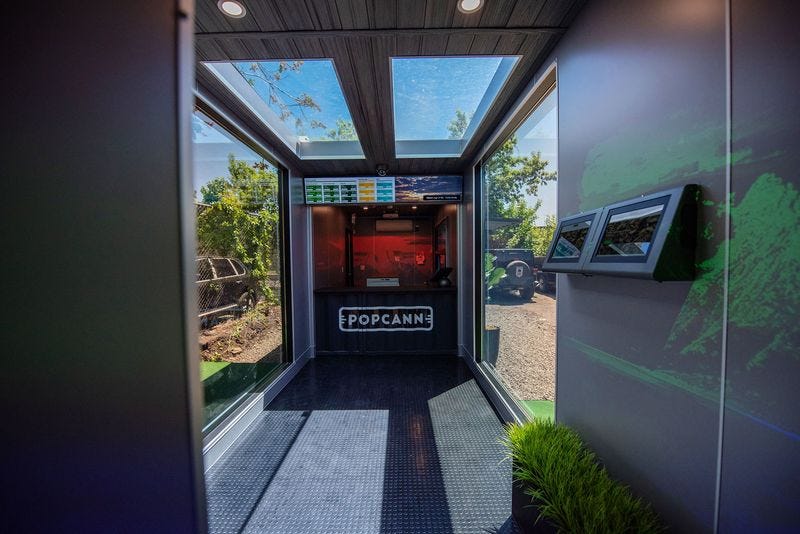
The interior of a Popcann pre-fabricated cannabis store.
For Popcann’s part, the company offers about eight different cannabis store layouts and can have the simplest versions up and running in 60 days, according to Popcann Chief Executive Officer Jake Neiman. He envisions having 10 Popcann stores open by the end of 2019 and 30 to 50 by the end of 2020. It will use Bridging Finance loans from around C$250,000 to C$500,000 depending on the size of the structure.
“The intent is to put up a loan to get a Popcann fully operational and recoup that loan after it’s generating income for that community,” Neiman said. “It’s kind of a no-risk, all-upside situation.”

Sunday, September 22, 2019

Indigenous-led Investment Group Partners with Peguis First Nation to Bring Legal Cannabis to Indigenous Communities.

WINNIPEG, June 18, 2019 – Bridging Finance Inc., one of North America’s leading infrastructure firms for First Nations and Inuit, is working with Peguis First Nation to bring safe Cannabis retail options to First Nation communities. The two organizations have engaged POPCANN to ensure that the sale of Cannabis is done in a secure manner that protects First Nation youth and eliminates black market product.

“Cannabis was legalized across Canada close to a year ago, but access to safe, legal product through retail has until now been limited to major urban centres, leaving rural communities at a disadvantage,” said David Sharpe, CEO of Bridging Finance Inc. “We’ve worked closely with Chief Hudson to ensure we’re doing something for the good of First Nation communities, and POPCANN is a great partner to help facilitate this endeavor.” To date, Bridging has allocated over $300 million to finance renewable energy, housing, grocery stores and fisheries to Indigenous communities.

The partnership aims to provide safe, controlled Cannabis retail stores that are compliant with both community and regionally imposed regulations, while at the same time providing elected Chief and Bands control over the sale of Cannabis within their communities.
The collaboration will also enable the three entities to work with various levels of government to establish dialogue and collaboration with regulators concerning cannabis related activities and policies within indigenous communities.

“First Nation communities do not have the same commercial and retail infrastructure that are ubiquitous in larger cities, adding an additional challenge,” said Chief Hudson, elected Chief of Peguis First Nation. “POPCANN’s prefabricated Cannabis retail stores offer a turnkey solution that means fast and secure access to safe quality Cannabis in our communities and the eradication of black market product.”
The first stores are expected to be operational by fall, 2019.

About Peguis:

Located approximately 190 KM North of Winnipeg, Peguis First Nation is home to Manitoba’s largest First Nation population. In total, there are approximately 11,000 Peguis Band Members, which includes membership both on and off-reserve and comprising mainly of Ojibway and Cree descent.

About Bridging Finance Inc.

Bridging Finance is a privately held Canadian company providing middle-market North American companies with alternatives to the financing options offered by traditional lenders. Lending proceeds, typically ranging from $3,000,000to $50,000,000 and higher, are used by companies to address short-term needs such as restructuring existing debt, providing working capital for growth, supporting inventory purchases and financing expenditures and acquisitions/buyouts. Bridging Finance is the manager of the Bridging Income Fund LP and the Bridging Mid-Market Debt Fund LP, Bridging Infrastructure Fund LP, and Bridging Real Estate Lending Fund LP. Bridging Finance also offers portfolio management services for institutional and family office clients. Bridging Finance’s total assets under management are over $1.4 Billion.

About POPCANN

POPCANNs are the only prefabricated Cannabis retail stores available in the North American marketplace for both pop-up and permanent installations. POPCANN’s mission is to provide turn-key Cannabis retail stores that rapidly bring legal Cannabis to traditional and alternative destinations.

POPCANNs are made to solve problems for diverse Cannabis stakeholders, including government regulators and the general public. Modular designs enable POPCANN to bring legal Cannabis to northern cities, Indigenous communities, music festivals, and seasonal towns.
The POPCANN Corporation, headquartered in Toronto, Canada, was co-founded in 2019 by veteran media and technology entrepreneurs Michael Girgis and Jake Neiman.


For further information: Media Contact: Kaitlyn Ward, PR Account Manager, kaitlyn@eightyeightagency.com, 416-944-2722